Hey, Everyone,
Welcome to part one of our examination of "Thread the Needle" by Sleep Token from their first EP "One." This is part one of ??? because I don't want to overwhelm anyone. It can be a lot. And I'm chatty. Really chatty. The point of this series is to teach you how to analyze texts in a chunkable, digestable fashion. Songs are basically "mini" texts to practice on, but that doesn't mean they lack depths of meaning.
Haven't heard "Thread the Needle" before? Click this link to listen to the song before we dive in: "Thread the Needle" by Sleep Token
If you aren't familiar with the history of Sleep Token, their earliest interviews, and their history, consider checking out these two videos by Glen Joseph Robinson, a very passionate Sleep Token fan and vocal coach:
Sleep Token History Part 1 by Glen Joseph Robinson
Sleep Token History Part 2 by Glen Joseph Robinson
For my part in all of this lore building, I'm going to be looking specifically at the auditory nature of the song in addition to the lyrics themselves. While I know that all Sleep Token fans have their own theories and such, this is all just my interpretation and a way to teach analysis skills in real time by looking at something very manageable: a six minute and 22 second song (okay so it's a long song, but a lot of it is instrumentals! not a ton of lyrics... not really, anyway.)
That said? Let's go.
When the video for Sleep Token's "Thread the Needle" opens up, we are almost immediately treated to Vessel's lyrical voice. At this point in the band's history, Vessel was the only consistent member (back in the olden days of 2016). Vessel II, or just II, would not join until EP "Two".
LYRICS:
Bury me inside this
Labyrinth bed
We can feel that time is
Dilated
In addition to the song, we are also greeted with the visual of a candle flame. These are all things to keep in mind as we start analyzing.
So we have music, we have Vessel's voice, the image on the screen, and we have the words in front of us. Where to now?
Well one of the things I look for when I'm going to analyze a song is where are the points of emphasis. Where does the singer take a breath? Where does the volume go up? Where does the pitch change?
If we were to apply this to the first stanza or verse of "Thread the Needle" it might look something like this:
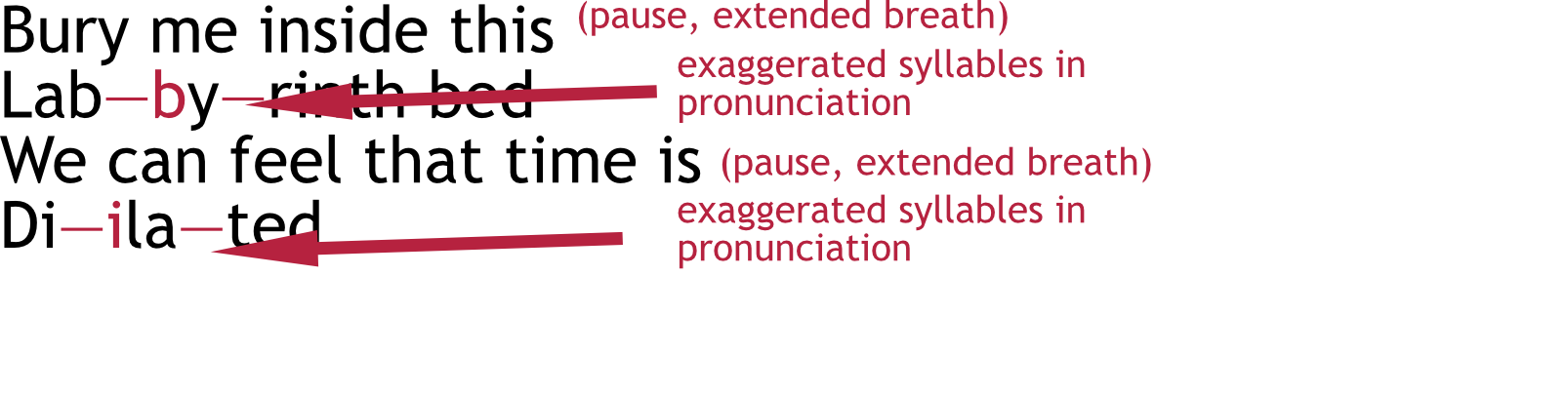
What does this mean by itself? Well, nothing yet. We're just noticing things. That's step one. What seems important here? What isn't important?
From listening to this first part of the first verse, two things jump out at me, likely at you, too, since we're looking at the same image. First: two words have exaggeration on the pronunciation, breaking the them down into their syllabic count (three syllables each). Second: each of those exaggerated words are preceded by an extended beat, almost like a breath.
Well, that seems like a good place to start to me. "Labyrinth" and "Dilated" are the two words that are seemingly emphasized.
From here, the question becomes, what do we know about either of these things? What's a labyrinth? What does dilated refer to?
Depending on who you are, how much reading you've done, what your cultural upbringing has been, etc... will determine how you answer these questions. For me, with an academic background, I play word association pretty quickly.
Labyrinth makes me think of the story of the minotaur and King Minos from Greek mythology— the inescapable "maze" that Theseus only manages to find his way out of with the aid of Ariadne's thread. Dilated, particularly when attached to the word time, means one of two things to me: either Einstein's theory of relativity or how time functions in narratives (time dilation versus time compression).
So, what does that matter when listening to a song? Potentially nothing, but when added back into context, we can consider some potential paths forward to either research or ruminate:
Bury me inside this,
Labyrinth bed.
So, the singer, Vessel as both character and vocalist, is asking for someone, some unseen presence, to bury him inside a bed that is likened to a labyrinth. Normally, when we think of beds, we think of comfort, of safety, of sleep (no, this is not a pun, I'm sure some will occur), of intimacy, of sex, of bodies. But this bed isn't all of those things: this is a burial plot, or what Vessel as a character wishes to be his burial plot.
At this point, I could go all Freudian and insist that this is the Eros and Thanatos drives at work, which maybe is an allusion worth exploring (Eros= life/sex drive; Thanatos= death drive, though it's a bit more complicated than that), or I could think: why is a labyrinth bed where Vessel, as a character in a musical theatre production, wants to be buried? What does my current knowledge about labyrinths lend to this discussion? What does the labyrinth have to do with death?
And honestly? I don't have much to add to this without using outside sources. I know the story of the labyrinth, and I know that labyrinths are meant to be "inescapable". That doesn't really contribute much to the conversation (though I would argue the idea of escape versus being trapped adds something, but where we're at right now doesn't say what it adds).
Want to see more? Make sure you subscribe to at least my free tier to see this content before I break it down for social media!


